SEO vs Google Ads: When to Choose Which for Your Business
WordStream analysed more than 17,000 campaigns and found that the average cost per click in Google Ads for 2024 is $4.66. In legal services — $8.94. In home services and construction — $6.96. In dental services — $6.82. Those amounts are charged for every click, regardless of whether the visitor called, enquired, or bought anything.
SEO doesn't work that way. There's no charge per click. But it doesn't produce results immediately either. That is the dilemma facing every business with a limited marketing budget: pay for fast visibility that stops the moment you stop paying — or invest in slow but permanent organic growth.
The right answer is not "one or the other." It's "each one at the right moment."
How Google Ads Works: A Tap, Not an Asset
Google Ads — paid search — is an auction. You bid to appear for specific keywords. When someone searches "emergency plumber London" and your campaign is active with a high enough bid, your ad appears. When the user clicks, you pay.
The result is immediate. A campaign can be live within hours of launching. That is the undeniable advantage of paid advertising. A newly opened business that needs clients this week cannot wait 6 months for SEO results.
But the mechanics are clear-cut: stop the campaign — stop the traffic. Not a gradual decline. An immediate halt. Everything paid for previously — every ad, every optimised headline — leaves no trace. The following month, the business is exactly as visible in Google as it was before the campaign launched.
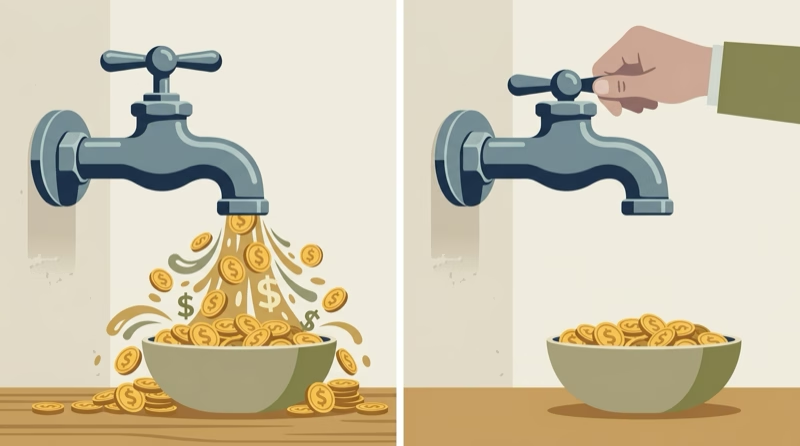
That's why Google Ads is a tap, not an asset. It works while it's open. Close it, and the flow stops.
How SEO Works: Property, Not Rent
SEO builds something that belongs to the business — organic rankings. A page that reaches position 1 for a keyword with 400 monthly searches stays there until a competitor works hard enough to displace it. It doesn't disappear when payments stop. It doesn't reset the effort already invested.
Ahrefs analysed 2 million web pages and found that pages ranking in position 1 are, on average, more than 2 years old. Only 1.74% of newly created pages reach the top 10 within a year. That sounds discouraging — but it means something important: once earned, an organic ranking is a defensive asset. Competitors need months of sustained effort to displace you. With paid ads, they just need to raise their bid.
The real cost comparison looks like this. In Google Ads, a business in home services might pay $6.96 per click. At 200 visitors per month, that's roughly $1,400 in click costs alone — every month. By month 12, over $16,000 has been spent without a single accumulated asset.
With SEO, the investment is concentrated in the build phase. By month 12, the organic rankings continue delivering traffic. By month 24 — the same. The spending is front-loaded; the returns compound forward.
SparkToro data shows that for every 1,000 searches on Google, 28.74% of clicks go to organic results and just 6.44% go to paid ads. Users are structurally more inclined to click organic results. That preference isn't coincidence.
When to Rely on Google Ads
Paid advertising is the right choice in specific circumstances — not as a permanent strategy.
A new business with no organic history needs immediate visibility to generate its first clients and revenue. SEO cannot help straight away. Paid ads can.
A seasonal business — ski equipment rental, corporate event planning for the holiday period — needs visibility within specific windows. Investing in SEO for year-round presence doesn't always justify the cost for a strongly seasonal operation.
Testing a new offering: before committing to a long-term SEO strategy for a new service or product, paid ads provide rapid feedback — do users click, does the page convert, does the message land? That data is worth having before the SEO investment begins.
Highly competitive keywords with a long SEO horizon: if the leading competitors for a keyword have 8 years of history and thousands of backlinks, ranking organically will take a very long time. Paid ads can provide visibility on those terms immediately — while SEO builds the long-term position in parallel.
When to Invest in SEO
SEO is the right choice when the business can operate with a 6–12 month horizon before significant results arrive.
An established business with a steady client flow, seeking to reduce dependence on advertising spend, is the ideal candidate for SEO investment. A business where clients regularly search for the service on Google — not just through referrals — has a direct incentive. A business that produces content regularly — a blog, guides, resources — already has the raw material to build organic authority.
Local businesses are a special case. The SEO timeline is shorter — local competition is far less intense than national — and the effect connects directly to physical customers. An optimised Google Business Profile can produce measurable results in weeks, not months.
The Right Framework: Not "Either/Or" But "When and How"
Framing seo vs google ads as a binary choice is a mistake. They're not alternatives — they solve different problems at different stages.
Launching a new business: run paid ads for immediate visibility while simultaneously building the SEO foundation — technically clean site, correct Google Business Profile, initial content. Six months in, organic rankings begin delivering traffic. Twelve months in, the ad budget can be reduced or redirected because the organic channel is carrying load.
An established business relying entirely on paid ads: SEO investment reduces the long-term cost of client acquisition. Every month that organic rankings deliver traffic is a month where advertising spend can be lower.
The question to ask is not "SEO or Google Ads." It's: "Where am I right now, and what type of visibility do I need today?" To answer that, you need to understand the mechanics of both. For the fundamentals of how SEO works — what it measures and why it takes time — read the complete guide to what is SEO for business owners.
The Strategic Conclusion: Is Visibility a Cost or an Investment?
Paid advertising is an expense. It delivers value, but it's transactional — money exchanged for clicks, repeated indefinitely. SEO is an investment. It builds an asset whose value grows over time and doesn't reset when payments stop.
"Investment" does not mean "cheap" or "risk-free." SEO requires real work, the right approach, and patience. A poorly executed SEO campaign can cost more than paid advertising — especially if it earns a Google penalty and requires months of recovery work.
The decision is strategic, not tactical. Businesses that succeed in organic search are the ones that decided early that Google visibility is an asset worth building — and had the patience to build it.