Website vs Social Media: Which One Actually Builds a Business Online?
On 11 January 2018, Mark Zuckerberg published an announcement that forced thousands of businesses around the world to reconsider their online strategy. Facebook would change the News Feed algorithm, he said, to show more content from friends and family — and less from brands and business pages. There was no warning. No transition period. The effect was immediate.
Businesses that had spent years building audiences of tens of thousands of followers watched their organic reach collapse. Not because they had done anything wrong. Because they had been building on someone else's land.
Facebook Organic Reach: The Numbers
Before moving to principles, the data is worth examining directly.
Social@Ogilvy — the research arm of agency Ogilvy — published an analysis finding that organic reach for branded Facebook pages had fallen 49% in just five months, settling at just above 6%. For pages with more than 500,000 likes, reach could fall below 2%. That analysis predates 2018. Today, close to a decade on from that finding, the numbers are lower still. According to Hootsuite data, average organic reach for a Facebook business post sits between 1% and 2% of a page's followers.
In practical terms: if you have 5,000 followers on your Facebook page, the average post is seen by 50 to 100 of them. The other 4,900+ don't see it — unless you pay.
Organic search operates on entirely different logic. According to BrightEdge research analysing billions of pieces of web content, organic search generates 53% of all web traffic. Social media — all platforms combined — generates around 5%. The gap is not small. It is more than tenfold.
Owned vs Rented Media — What the Distinction Actually Means
Digital marketing distinguishes between "owned media" and "rented media." The distinction describes the degree of control.
Owned media includes your website, your email list, and any content published under your own domain. You decide what is shown, to whom, when, and how. Nobody can change the rules without you.
Rented media includes everything that lives on a platform owned by another company: a Facebook page, an Instagram profile, a LinkedIn presence, a TikTok channel. These platforms let you build — but they own the land. They can change the algorithm, restrict your reach, remove your account, or shut down the platform. All of these things have happened.
The 2018 Facebook case is well-documented. But it is not isolated. Instagram has reduced organic reach multiple times. LinkedIn has expanded and contracted the visibility of business posts in different periods. TikTok faces legislative restrictions in multiple countries. Every one of these changes directly affects businesses that built their primary online presence there.
What Social Media Does Well
An honest analysis requires acknowledging that social media is not useless. It does certain things well.
It is effective for social proof — customer reviews and recommendations visible on a Facebook page have a real effect on new customers' decisions. It works for engaging an existing audience with updates, promotions, and announcements. It is a useful tool for paid advertising if you have the budget — Facebook Ads remains a powerful instrument for targeted advertising when configured correctly.
But each of these advantages is conditional. It depends on the policies of the platform and on the algorithmic decisions of a company whose priorities do not align with yours. The engagement you build there does not belong to you.
A Website as Business Infrastructure
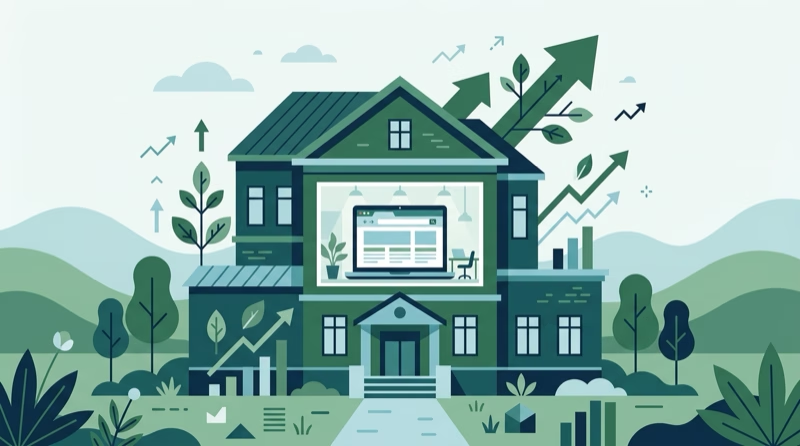
A website works differently. It is infrastructure — like owning an office rather than renting one. The costs are different; the control is incomparable.
Content published on your website is indexed by Google and can generate organic traffic for years after publication. An article written today may be attracting new customers five years from now — with no additional spend. A Facebook post from five years ago does not functionally exist.
Your domain builds authority over time. Google ranks websites partly on the basis of their history, reputation, and consistency. Every new site starts from zero; an established domain with quality content has a competitive advantage that accumulates gradually and cannot be replicated quickly.
Eurostat's 2023 data shows that a significant share of businesses across Europe still lack a website — well below the rates in Finland, Germany, and Denmark, which all exceed 90%. For businesses that understand the difference, that gap is not a threat. It is a market opportunity.
Both — But Not for Equal Reasons
The answer to the website vs social media question is not a binary. It is about understanding the different function of each.
A website is the foundation. It is the asset you own, indexed by Google, accessible around the clock, growing with your business. The content there compounds over time. The investment accumulates.
Social media is an amplifier — useful, but unreliable. It distributes, engages, and advertises. But it does not replace the foundation.
A business without a website, relying solely on a Facebook page, has built its online presence on land it does not own. An algorithm change — documented, recurring, and inevitable — can erase years of built visibility in days. A website is not affected by decisions made at Meta's headquarters.
If you are still not certain what a website actually is and what makes it different from a Facebook page as a business tool, read what is a website — the complete guide for business owners.